


Every day, thousands of hours of premium audio content disappear into the ether.
The live radio show ends.
The mic goes quiet.
The audience moves on, and with them so does a revenue stream.
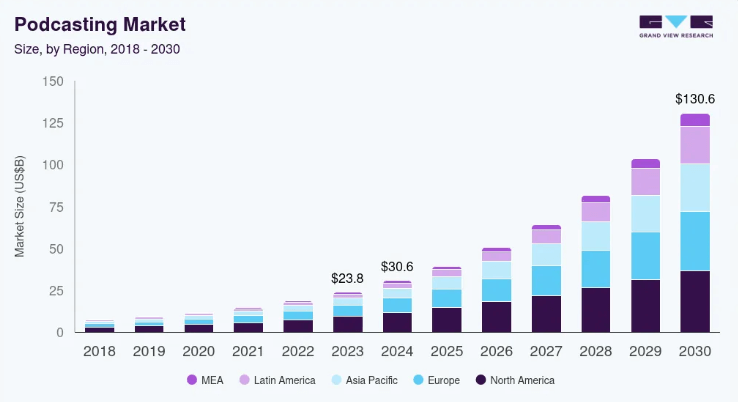
Grand View Research estimates the global podcasting market at USD 30.72 billion in 2024, with projections to reach USD 131.13 billion by 2030. That growth is already turning into revenue for creators who make their content available when and where audiences want to listen. Yet, the vast majority of radio content stays locked inside a live clock. It’s already been produced, it’s compelling, and it’s already loved by listeners, yet the content is rarely repurposed for podcast platforms. For radio, that gap is a massive opportunity to turn existing programming into new on-demand inventory, audience growth, and incremental digital revenue.
Some forward-thinking broadcasters are already capitalizing on this opportunity.
Major market radio groups are turning their full daily lineups into podcast feeds. Entire shows that are segmented and posted build massive content libraries that fuel passive listening and open new sponsorship inventory.
News stations are packaging their morning shows into commuter-friendly podcast episodes so their audiences stay connected well outside their broadcast range.
Sports networks are breaking down three-hour shows into topic-specific episodes, making their podcasts discoverable to fans searching for specific teams, players, or games.
Public radio brands reach younger listeners who would never tune into traditional radio but will gladly follow and subscribe to a podcast.
So why aren’t all broadcasters capitalizing on this opportunity?

The Hidden Cost of Letting Shows End at The Tower
Radio networks and publishers face a deceptively simple problem. They create incredible content daily, but distribution stops at the broadcast tower.
On paper, converting live shows into podcasts sounds simple. But in practice, it’s anything but.
The traditional workflow creates a long to-do list:
- Pull recordings and extract segments.
- Remove promos, station breaks, and dead air.
- Edit transitions and add intros and outros
- Adjust and normalize audio levels.
- Write show notes, descriptions, and episode titles.
- Create episode metadata and tags for podcast platforms and SEO
- Publish to multiple destinations and monitor each.
Now multiply that work across several dayparts, multiple stations, and a small team. The result is predictable: burnout. Producers and digital teams run out of bandwidth. Podcast production falls behind. Strong shows never reach on-demand platforms.
For many broadcasters, the issue is not a lack of podcast strategy. It is the manual workload that sits between a great show and a published episode.

How AI Turns Live Broadcasts Into On-Demand Assets
This is where Futuri’s POST is changing the equation entirely. It is built to solve this problem for broadcasters. POST simplifies and accelerates podcast production, distribution, and monetization, so teams can repurpose shows without overwhelming staff.
Work that used to require hours shifts into a workflow measured in minutes, transforming live broadcasts into polished, platform-ready podcast episodes with minimum workload.
Here’s what modern automation handles:
-
-
- Content Extraction: POST analyzes show audio, identifies segments, and classifies elements such as talk breaks, music, commercials, station promos, etc. Producers see clear sections to review rather than sifting through an entire log. This shortens the time between broadcast and podcast release.
- Episode Automation: Teams select the segments they want to repurpose. POST then assembles those segments into full podcast episodes, offering options for different formats such as full show, best-of, or topic-specific cuts. POST also generates show notes, descriptions, artwork, and SEO-focused titles and tags that help with podcast discovery and search
- Multi-Platform & Video Publishing: From one workflow, POST publishes episodes to your station site, major podcast platforms, and connected destinations. That includes Spotify, Apple Podcasts, and YouTube. Audio can be paired with simple video assets for YouTube or social channels without a separate editing process.
- Built-in Sponsorship and Ad Insertion: Pre-roll, mid-roll, and post-roll positions are integrated directly into the workflow. This turns your archive into a real on-demand ad environment, long after the original airdate. Combined with programmatic and direct-sold campaigns, those episodes become ongoing revenue assets instead of one-time content.
- Integration with your existing systems: POST is designed around broadcaster workflows. It integrates with leading automation and playout systems such as WideOrbit, RCS, and NexGen, which keeps engineering and operations comfortable. Teams stay in familiar environments while adding new digital output.
For News Directors, Program Directors, and Digital Content Managers, this means less manual podcast production and more focus on content strategy. Producers stop spending large blocks of time on repetitive cutting and pasting. Talent and sales teams see more long-tail value from the effort they already put into every show.

-
-
What Podcast Production Means for Revenue
If you start with one strong show, let’s say your morning drive program. The audience is loyal. The brand is known in the market. If that show becomes a reliable podcast with consistent enterprise-level podcast production, even conservative download numbers can create new income.
At a modest CPM of $10, capturing just 10,000 downloads per month creates significant new revenue when you factor in standard pre-roll and mid-roll positions. Potentially $24,000 annually in additional revenue.
Now imagine replicating that same approach for three shows; that’s an additional $72,000 per year. And if you already have five shows on air and turn them all into podcasts, that’s a potential extra $120,000 per year. These are conservative figures. When episodes are optimized for production, discovery, and SEO, many networks see higher download counts, and CPMs often exceed $10.
But the opportunities podcasting creates extend beyond advertising units.
- Audience expansion: Podcast listeners discover your broadcast station and tune in live
- Brand partnerships: Exclusive podcast series for sponsors
- Archive monetization: Your entire back catalog becomes evergreen inventory
- Licensing opportunities: Quality content packaged for syndication to other markets
- Event promotion: Drive ticket sales for station events and live broadcasts
- Talent leverage: Hosts can build personal brands that benefit the entire network
Networks that move to an automated on-demand workflow report ROI within months, often paying for the technology with revenue from just one show. Everything after that is margin and growth.
Why Now?
The convergence of three factors makes this the right moment to act:
- Podcast listening is mainstream: Research from multiple industry sources shows more than 100 million Americans listen to at least one podcast each month. For younger demographics, podcasts sit alongside music streaming in daily routines. If your station does not appear in those feeds, another brand fills that attention.
- Expectations for on-demand access keep rising: Audiences expect to listen on their own schedule and device. They scan their favorite podcast apps, smart speaker prompts, and YouTube subscriptions. If a listener misses your morning show, they still expect an easy way to catch key segments. If you do not offer that option, they are likely to move on.
- Automation has removed most of the friction: Futuri POST automates the most tedious and manual parts of turning radio shows into podcasts. Teams gain a repeatable podcast production workflow that fits into existing operations without adding headcount. The barrier is no longer technology. The barrier is the decision to move.
The Bottom Line
Your content is already your most valuable asset. You invest in talent, storytelling, and local connection every day. The question is whether your strategy stops at live broadcasts or includes podcast listeners who prefer on-demand.
While you’re reading this, your competitors are building podcast audiences, opening new revenue streams, and creating content libraries that will compound in value for years.
The technology exists. The market is ready. The only thing missing is action.
Ready to Turn Your Broadcasts Into New Automated Revenue Streams?
Contact us today to explore your digital audio strategy. A short conversation often reveals more podcast and digital audio revenue in your current lineup than you expect.
Request a Demo